
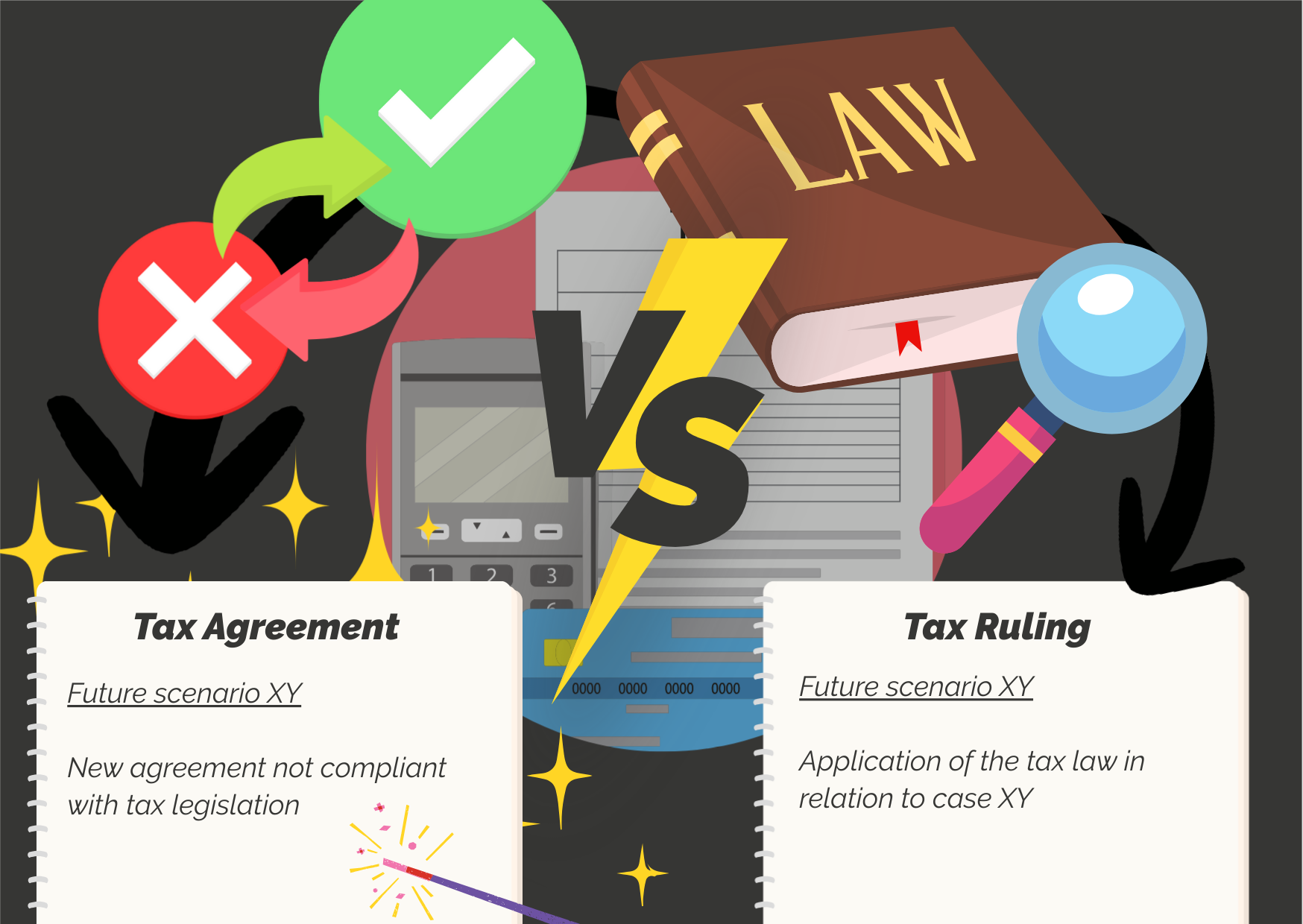

In advisory practice, it is evident time and again that entrepreneurs, investors and private taxpayers seek a high degree of planning certainty. This is entirely understandable, as many of their decisions have direct tax consequences. This is especially true where complex transactions are envisaged or significant financial implications are expected.
A recent client matter illustrated this point well.
The client asked me:
“Could we not simply enter into an individual agreement with the tax authority regarding the applicable tax rate?”
The question is perfectly understandable from a commercial perspective and reflects the instinctive approach many people take. However, it also reveals a widespread misunderstanding of what is legally permissible under Swiss tax law – and, in particular, which instruments Swiss law actually provides.
The desire for an individualised solution often stems from a legitimate need for predictability. Yet it overlooks a crucial fact: Swiss tax authorities are strictly bound by statute. While an advance tax ruling is an established, legally recognised and sensible tool for both taxpayers and the authorities, so-called tax agreements – in the sense of arrangements that deviate from statutory provisions – are not only impermissible, but legally void.
To understand this distinction clearly, it is worth examining the legal basis, purpose and limits of these two concepts in more detail.
Advance Tax Rulings
Definition and Legal Framework
An advance tax ruling (Steuerruling), also referred to as a tax pre-assessment or Steuervorbescheid, is a binding advance statement issued by the competent tax authority regarding the tax consequences of a specific and yet-to-be-implemented set of facts.
The practice of issuing advance rulings is rooted in the constitutional principle of legitimate expectations (Art. 9 of the Federal Constitution) and in general principles of administrative law. Tax authorities are required to provide consistent, transparent and comprehensible guidance where statutory provisions contain indeterminate legal concepts or allow for interpretative discretion.
For an advance ruling to be binding, several conditions must be met:
- The facts must be disclosed in a detailed, complete and accurate manner;
- The taxpayer must implement the transaction exactly as described;
- The authority must be competent for the tax in question;
- The ruling must be issued within the limits of the applicable law.
This means that the authority may not create new rules or deviate from statutory law. It may only clarify how it will apply the law to the specific facts presented.
Purpose and Function
Advance tax rulings serve several important purposes:
- Legal certainty
In tax-sensitive or economically significant cases, taxpayers have a legitimate interest in reliable predictions. A ruling avoids later disputes and provides clarity. - Planning certainty
In restructurings, cross-border structures, employee participation programmes or real-estate transactions, precise knowledge of the tax consequences is essential. - Procedural efficiency
Early coordination between the taxpayer and the authority reduces the administrative burden for both sides, particularly in complex matters. - Protection of legitimate expectations
If the taxpayer implements the facts exactly as agreed, the authority is generally bound by its ruling. This protects investment decisions and contributes to the stability of the Swiss tax system.
Examples from Practice
Advance rulings are commonly used for matters such as:
- Tax-neutral corporate restructurings (Merger Act / Art. 61 Federal Act on Direct Federal Taxation – DBG)
- Valuation of employee participation schemes
In all these examples, the purpose is not to modify the law, but to determine how the existing statutory framework applies to a particular set of facts.
Tax Agreements
Definition and Legal Classification
In international tax law, the term “tax agreement” typically refers to double taxation agreements (DTAs). These are, of course, permissible and form part of Switzerland’s treaty network.
However, in the context of my client’s question, “tax agreement” meant something entirely different: an individual arrangement between a taxpayer and the tax authority that leads to a tax outcome contrary to statutory law.
Such arrangements might include:
- An individually negotiated tax rate
- A waiver of taxes based on agreement
- An alternative method for calculating tax
- A private contractual arrangement modifying statutory obligations
These types of agreements are strictly prohibited under Swiss law.
Why Individual Tax Agreements Are Impermissible
Swiss tax authorities are bound by the principle of legality (Art. 127 para. 1 Federal Constitution): Taxes may be levied, reduced or altered only where the law expressly provides for it.
This has clear implications:
- Authorities may not negotiate tax rates or the tax base.
- They may not agree on outcomes not anchored in statute.
- There is no statutory provision permitting individual deviations.
The principal tax acts – in particular the Federal Act on Direct Federal Taxation (DBG), the Federal Act on the Harmonisation of Direct Taxes of Cantons and Municipalities (StHG), the Value Added Tax Act (MWSTG), the Federal Withholding Tax Act (VStG) and the Stamp Duty Act (StG) – contain no basis for individualised tax arrangements.
From an administrative-law perspective, any such agreement would be:
- ultra vires,
- unlawful, and
- void (by analogy to Art. 36 Federal Act on Administrative Procedure – VwVG).
Accordingly, the legal position is unequivocal: A tax agreement leading to a tax outcome diverging from statutory law is invalid.
Conclusion
Legal certainty is achieved not through individual deals, but through properly obtained advance tax rulings.
Advance tax rulings are a cornerstone of legal certainty in the Swiss tax system. They allow businesses and private taxpayers to make informed decisions without resorting to impermissible shortcuts.
Individual tax agreements, by contrast, are unequivocally unlawful. They violate fundamental legal principles, jeopardise equal treatment and are ultimately null and void.
Those seeking clarity must therefore follow the correct and lawful path: Do not negotiate. Obtain an advance tax ruling.
This approach is legally sound, transparent, binding for both sides and highly effective in practice.
